
Harman Kaur did not set out to write for everyone. She set out to write for the ones who had rarely seen themselves on a page. It started with a collection of poems she began at the age of 16, called ‘Phulkari’ (2018). It followed with her next collection, ‘Call Me Home’ (2025). And soon, ‘What the Rivers Remember’ (set to come out in spring 2027).
That quiet and resolute intention to represent her ‘kind’ has carried the Canadian-born poet from a self-published debut at 21 to stages across North America. Her first book sold out of 250 pre-ordered copies in less than two weeks. It went on to earn 4.8 stars across 177 Amazon reviews, as well as 4.5 stars across 233 reviews on Goodreads (as of May 2026).
Her works garnered her influencer status on TikTok and Instagram, where she currently holds 59K and 45K followers, respectively. Her TikTok profile reports 4.6 million likes.
Harman Kaur’s ability to bring something new to a large, diasporic audience drew the attention of Central Avenue Poetry and Simon & Schuster, book houses that collectively published and now distribute ‘Call Me Home.’ With confidence, and with proof of resounding success, they have also committed the same for ‘What the Rivers Remember.’
Writing a people into existence
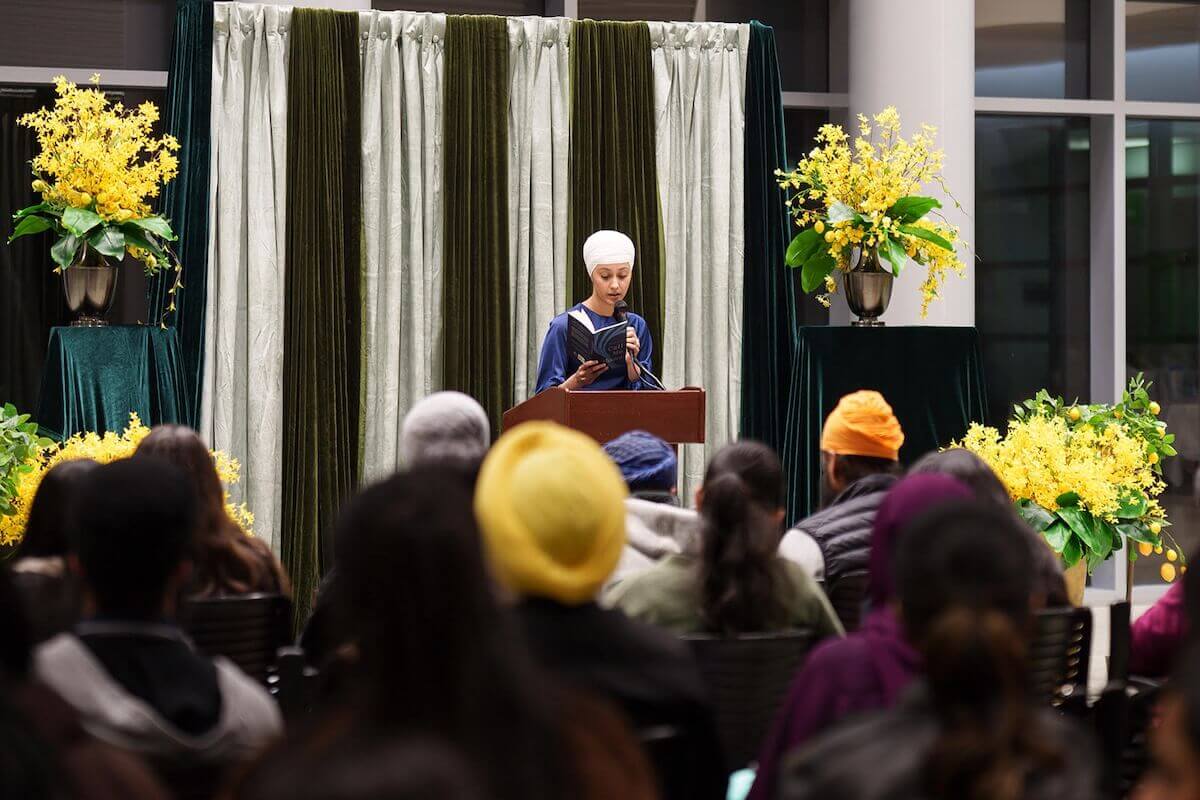
Harman Kaur grew up in Abbotsford, British Columbia, an area where Punjabis were plentiful and visibility felt natural. Her parents were deliberate about keeping her rooted in the culture — ensuring she could read, write, and speak Punjabi fluently. That groundedness spared her an identity crisis that she says many in the diaspora quietly endure. But grounding is not the same as immunity. She says discrimination found her regardless. That experience deepened her awareness of Punjabis growing up in towns where the effort to stay proud of one’s roots can demand something harder.
Between the ages of 16 and 20, she began turning those observations into poems. The collection that emerged was ‘Phulkari.’ It was named after traditional Punjabi embroidery. Its literal translation to English is “flower work.” Each chapter showcases a written panel of colourful expression and the result of being ‘stitched’ into something beautiful.
In an interview with a local Abbotsford newspaper, Harman Kaur reported that a conventional publisher expressed interest in the book, but asked for too many changes she was unwilling to make. She felt artistic integrity was more important. So, at the age of 21, she chose to self-publish.
Harman Kaur put out 250 pre-order copies; they sold out in under two weeks.
‘Phulkari’ went on to earn rave reviews. It was stocked at Chapters and Indigo locations across B.C. It now sells across five European countries — Germany, France, Italy, Spain, and the Netherlands — reaching places she herself has never been.
In 2018, a California-based Sikh advocacy organization, Jakara Movement, sponsored a statewide tour for the book. It was during that tour that Harman Kaur met her husband — a turn of life that would relocate her to the Bay Area in California, USA. Eventually, it would shape the theme she would write about next.
She was also invited to perform poetry readings at Princeton and Rutgers University in New Jersey, as well as California’s UCLA, UC Irvine, UC Berkeley and others. She has also made regular appearances as a speaker at the annual Sikh Heritage Month celebrations in Canada.
In November, 2026, she will present the keynote at the annual Dhahan Prize Ceremonies in Surrey, B.C. The organization is internationally known for offering the largest monetary award of its kind to writers of the best Punjabi fiction.
A love letter to home, written from its absence
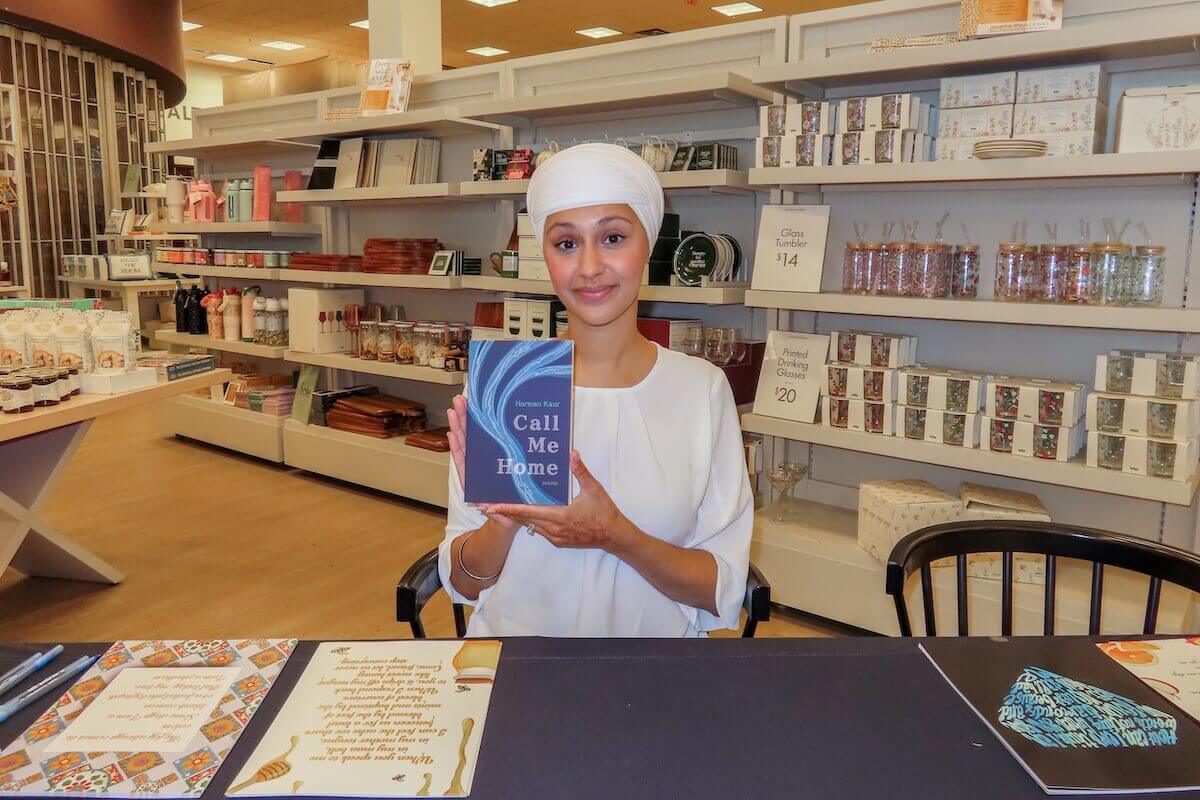
‘Call Me Home’ (Central Avenue Poetry, distributed by Simon & Schuster, 2025) arrived after Harman Kaur married and left Canada — the only home she had ever known.
“‘Call Me Home‘ was written at a time when I got married and moved away from Canada,” she explains. “This is why I explored the theme of home.”
The collection stretches that theme past four walls — into womanhood, spirituality, immigration, grief, and the quiet inheritance of intergenerational emotion. It reached readers beyond the Punjabi Sikh community, and its reception reflected that breadth.
Simran Jeet Singh, national bestselling author of ‘The Light We Give,’ described it as simultaneously “familiar” and “unsettling.” He said he found reflections of his own life as a Sikh within many of the poems. He was also reminded that they “offer a glimpse into others’ experiences.”
Ari B. Cofer, author of ‘Paper Girl and the Knives That Made Her,’ praised its careful navigation of womanhood and grief.
Hinnah Mian, author of ‘Pangaea,’ called it the poetry collection she wished she’d had growing up — writing that, as a Pakistani-American, Harman Kaur’s words “gave voice to feelings” she had spent her whole life trying to understand.
A second edition of ‘Call Me Home’ is now in development with a publisher in India.
Michelle Halket, publisher at Central Avenue Poetry, was unequivocal: “’Call Me Home’ has been our breakout book of the year.”
When Harman Kaur’s third collection came into view, Halket did not wait. “When I found out she was writing her next book, I immediately asked if she’d consider publishing with us again,” she wrote publicly on Instagram. “Harman writes with such tenderness, love, and immediacy about her home, culture, family, and experiences that I’m truly honoured.”
Writing poetry to move memories forward
‘What the Rivers Remember’ (forthcoming, spring 2027) turns toward memory — what is held, and what is released. Written over a single year, it draws from new motherhood and the layered, unresolved relationships between mothers and daughters.
“This is my most painful and raw collection of poetry yet,” Harman Kaur says. “I’ve had to reach back into myself and access memories that I’ve been trying to forget and remember just to write this book.”
The themes, as with each of her books, arrived from her life’s journey.
A father’s passion, a daughter’s poetic continuation
Harman Kaur is fluent in both Punjabi and English. The choice to publish in English while expressing Punjabi Sikh identity was partly intentional, and partly an inheritance from her father.
In his original home of Punjab, India, her father earned a Master’s degree in English and worked as a lecturer and teacher of the subject. After immigrating to Canada, that chapter of his life quietly closed.
“I saw how passionate he was about it and felt sad that he wasn’t able to pursue it further in Canada,” she recalls. “This encouraged me to embrace it and I fell in love with it.”
Growing up bilingual, she says there is a difference between being fluent, and being “poetically fluent” in a language. Her poetic fluency, she says, is mainly with English.
“I have always been fascinated with storytelling, but more so the ability of poetry to tell stories in such little words,” she explains. “Poetry fit like a glove.”
While English is where she finds her ‘flow,’ translating her collections into Punjabi remains a goal.
In addition to her poetry, she self-published an English-language Sikh spiritual guide in 2024 titled, ‘Conversations With My Guru: A Sikh’s 365 day journey of self-reflection.’
The process behind the poems
Ideas come to Harman Kaur at unexpected hours — a phrase, an image, a feeling — and she captures them in her phone’s Notes app before they dissolve. When the time comes to write, she reaches for pen and paper to start the first draft. She then moves to the computer to edit and refine.
Her creative ritual is specific: an instrumental Harry Potter mix plays in the background. An iced latte sits nearby.
Teaching the language, keeping the people
Alongside her writing, Harman Kaur teaches Punjabi — a vocation entered with purpose. She sees language preservation as inseparable from cultural survival.
“If a language is lost, then so are the people,” she says.
She believes Punjabi holds a place no translation can replicate. “I love how deep it is,” she reflects. “If you translate it into English, you strip it of its beauty.”
On staying true
The advice she offers aspiring writers is the same principle that has guided her own career: resist the pull toward the universal at the expense of the specific.
“Too many times I have had the urge to write about something ‘universal’ so everyone can relate to what I am writing, but this results in an erasure of my identity and unique experience,” she says. “I promise there is someone out there who needs your story.”
Harman Kaur graduated from Simon Fraser University in 2020 with a Bachelor of Arts in English. She plans to pursue a Master of Fine Arts (MFA) in Creative Writing when her children are older. She is currently a full-time mother to a two-year-old and a two-month-old.
